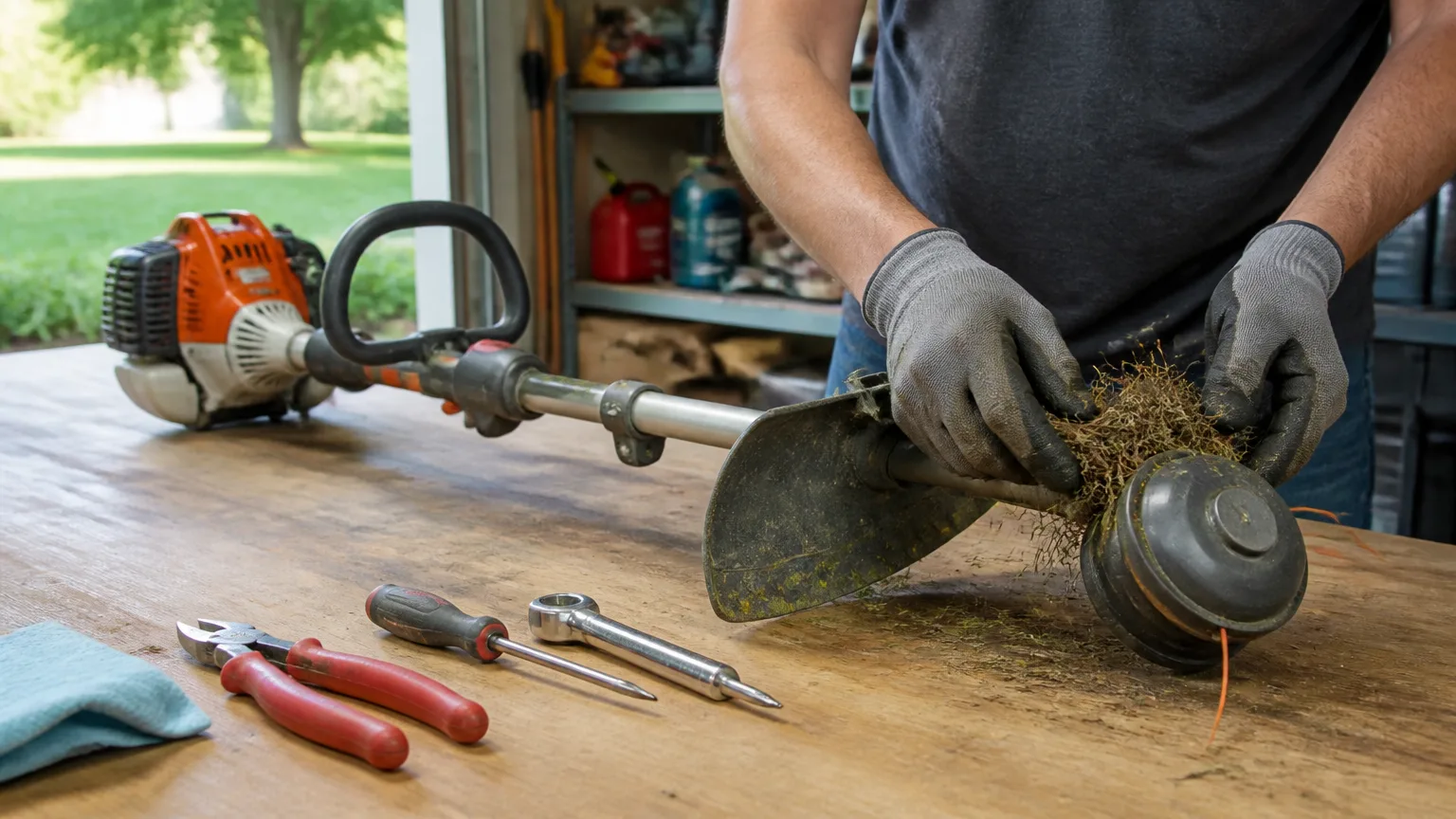
String Trimmer Head Will Not Spin: Common Drive and Clutch Problems
When a string trimmer head will not spin but the engine starts and runs, the problem is usually somewhere between the engine’s clutch and the cutting head. That path may include a clutch, an inner drive cable or shaft, a coupler, a gear head, and the trimmer head itself. The best repair starts with simple external checks before assuming an internal part has failed.
Safety first: Stop the engine, let hot parts cool, and disconnect the spark-plug wire before handling the head, shaft, or clutch area. For a battery trimmer, remove the battery. Wear gloves when clearing line, grass, or debris, and use the exact owner’s manual for attachment-removal and service instructions.
A weed eater engine runs but head does not spin for different reasons depending on whether it has a straight shaft, curved shaft, split shaft, gear head, gas engine, or battery powerhead. Avoid forcing the head, revving the engine excessively while troubleshooting, or disassembling a clutch unless you are prepared to follow the model-specific manual.
Start with the simplest cause: a trimmer head seized by debris
Long grass, string, wire, vines, and packed dirt can wind behind the spool or around the output shaft. This can make the trimmer head seized, prevent it from turning freely, or create enough resistance that the drive system slips.
Husqvarna’s support guidance for a head that does not spin freely begins with turning the product off, removing the cutting head as directed for the model, and clearing tangled grass and debris. ([us-support.husqvarna.com](https://us-support.husqvarna.com/en/petrol-powered-trimmer/Trimmer-head-does-not-spin-freely-9fa3?utm_source=openai))
- With power disconnected, try turning the cutting head by hand.
- Look behind and beneath the head, not only around the exposed spool.
- Remove wrapped vegetation carefully rather than pulling hard against the shaft.
- Check that the bump knob, spool, cap, and any washer or drive cup are installed in the correct order.
- Reinstall the head only as specified in the owner’s manual. Thread direction and retaining hardware vary by model.
If the head turns smoothly once cleaned and then works normally, the trouble was external binding. If it remains difficult to rotate by hand with the engine off, do not continue running the trimmer until you identify the bind. A damaged head, bearing housing, or gear head can worsen quickly under power.
Use this diagnostic order when the string trimmer head will not spin
Working in order helps separate a head problem from a string trimmer drive shaft problem or an engine-side clutch issue.
- Confirm the engine reaches normal operating speed. If it idles but bogs badly when throttled, the clutch may not reach its engagement speed. Address the engine-running problem before condemning the drive system.
- Check whether the head is physically stuck. Clear debris and verify free movement with the engine off.
- Inspect the head mounting and output area. A loose, damaged, or incorrectly installed cutting head may not be driven properly.
- Inspect shaft connections. This is especially important on detachable, split-shaft, or recently serviced trimmers.
- Listen for drive clues. A revving engine with no head movement, rattling, scraping, or intermittent engagement can point toward a worn clutch, stripped drive fitting, damaged cable, or gear-head problem.
- Stop at internal disassembly if needed. Clutch, drive-cable, and gear-head repairs can be model-specific. Use the exact manual or have an authorized service professional inspect it.
Common string trimmer drive shaft problem signs
On many shaft-drive trimmers, engine power travels through an inner flexible cable or solid shaft to the cutting end. A straight-shaft unit may also use a gear head to change the direction of rotation at the head. ECHO describes the flex cable as the component that transmits power through the shaft, while the gear head converts that rotation for the cutting head. ([echo-usa.com](https://www.echo-usa.com/product-knowledge/grease-flex-cable-trimmer?utm_source=openai))
A drive-shaft fault is more likely when the engine sounds normal at higher throttle but the head stays still, turns only occasionally, or turns briefly before stopping. Depending on the design, likely issues include:
- A shaft housing that has slipped out of its correct position at the powerhead.
- An inner cable or shaft that is worn, broken, rounded off, or insufficiently engaged at one end.
- A damaged coupler on a split-shaft model.
- A worn drive fitting in the head or lower gear housing.
- A dry, damaged, or failed gear head on a model equipped with one.
Check powerhead-to-shaft engagement after service or transport
If the shaft has recently been removed, loosened, or bumped loose, the inner drive may no longer be fully engaged with the clutch mount. ECHO operator manuals instruct users assembling certain trimmers to ensure the inner drive shaft engages the clutch mount and to align and secure the shaft housing correctly. ([echo-usa.com](https://www.echo-usa.com/getattachment/4db74aa3-ecfa-426b-a6b9-693f6ee2c545/filev2_?utm_source=openai))
Do not guess at alignment marks, bolt positions, or insertion depth. Follow the procedure in your own manual. A shaft that is only partly engaged can produce a no-spin condition and may damage the drive ends if the engine is operated under load.
Do not confuse lubrication needs with a guaranteed repair
Some trimmers require periodic drive-cable or gear-head lubrication, while others have different maintenance arrangements. ECHO notes that maintenance intervals vary by model and advises consulting the operator’s manual for the correct interval and procedure. ([echo-usa.com](https://www.echo-usa.com/product-knowledge/grease-flex-cable-trimmer?utm_source=openai))
If inspection reveals a dry cable, discoloration, metal dust, missing splines, or a rough gear head, lubrication alone may not solve the problem. Replacing worn components—or having them evaluated professionally—is safer than trying to make damaged drive parts work.
Trimmer clutch failure symptoms to watch for
Most gas string trimmers use a centrifugal clutch. At idle, the head should generally remain still or nearly still; as engine speed rises, the clutch engages and transfers rotation into the drive shaft. A clutch can wear, overheat, crack, become contaminated, or lose spring tension.
Possible trimmer clutch failure symptoms include:
- The engine revs freely but the head never turns, even though the head and shaft are not seized.
- The head begins turning only at unusually high throttle or engages inconsistently.
- The trimmer makes a metallic rattle, scraping sound, or burning odor near the engine-side clutch area.
- The head stops when it contacts normal grass even though the engine continues running strongly.
- The drive shaft is properly seated, but no rotation reaches it.
These symptoms are clues, not proof. A stripped inner cable or damaged gear head can feel much like a clutch failure from the operator’s position. Replacing a clutch without checking the rest of the drive path can waste time and money.
When an engine problem can mimic a clutch problem
If the engine cannot accelerate properly, the clutch may never receive enough speed to engage. A clogged air filter, fuel-delivery trouble, incorrect carburetor adjustment where applicable, or exhaust restriction can all make a trimmer feel as though the head drive has failed.
For a related explanation of how an engine fault can limit high-speed operation, see Why Your Lawn Mower Only Runs With the Choke On. The exact systems differ, but the diagnostic principle is the same: verify the engine can run correctly before replacing driven components.
Head and gear-head faults that stop rotation
The cutting head itself can fail internally. A worn drive cup, stripped threaded insert, cracked spool carrier, damaged bump-feed mechanism, or incorrectly fitted replacement head may allow the output shaft to turn without reliably driving the line spool.
At the lower end of certain straight-shaft trimmers, a gear head or gear housing transfers power to the output shaft. Warning signs of a lower-drive issue include resistance when rotating the head by hand, grease leakage, roughness, grinding, excessive heat after brief operation, or play at the cutting end.
Do not pack a gear case with an unspecified lubricant, overfill it, or remove components simply to inspect them unless your manual specifically supports that service. The proper grease, quantity, intervals, and access points are model-dependent.
What you can check yourself—and when to stop
Reasonable owner checks
- Remove the battery or disconnect the spark plug and clear debris from the head.
- Inspect the head for cracks, missing retainers, and improper assembly.
- Check that the shaft is secure at the powerhead and, on a split-shaft unit, fully locked at the coupler.
- Verify that the engine will accelerate normally without forcing the cutting head into heavy growth.
- Consult the exact owner’s manual for approved head removal, shaft installation, and lubrication instructions.
Use a service professional when
- The head is free but the engine revs and no drive reaches the cutting end.
- The shaft, clutch, or gear housing makes abnormal mechanical noise.
- You find stripped splines, a broken cable, cracked clutch parts, or a damaged gear head.
- The repair requires clutch removal, engine housing removal, or internal gear-head work.
- The trimmer is under warranty or you are unsure which replacement parts fit the model.
Bottom line
A string trimmer head will not spin most often because the head is bound with debris, the shaft is not transferring power, or the gas-engine clutch is not engaging. Begin with a safe, engine-off inspection of the head and mounting area. Then verify the shaft connection and engine performance before treating the problem as a clutch failure.
When the head is free, the engine runs strongly, and the drive still does not reach the cutting end, stop using the trimmer and consult the exact owner’s manual or an authorized service professional. That is the point where a worn drive cable, clutch, coupler, or gear head becomes the more likely repair.


