Air Compressor Pressure Switch Will Not Shut Off: Safe Overpressure Checks
An air compressor pressure switch will not shut off situation is not a normal “keep an eye on it” problem. The pressure switch is meant to stop the motor at its preset cut-out pressure. If it does not, tank pressure can continue rising until the safety valve opens—or until another component is stressed beyond its intended operating condition.
Safety first: If tank pressure rises past the normal cut-out point, move the compressor’s On/Off control to OFF immediately. If the motor continues to run, unplug it only if you can do so safely, keep clear of the tank and fittings, and do not operate the compressor again until it has been serviced. Never adjust or defeat the safety valve or pressure-control components.
This guide covers safe observations and shutdown steps for a compressor that keeps running past cut out. It is not a procedure for calibrating a switch, defeating a control, or working inside an energized pressure-switch cover. Exact layouts, cut-out settings, and approved replacement parts vary by model, so use the owner’s manual for your specific compressor and use an authorized service professional for internal electrical or pressure-control repairs.
Why an air compressor pressure switch will not shut off is urgent
The pressure switch monitors tank pressure and automatically starts and stops the motor between factory-set cut-in and cut-out points. On a typical portable unit, the regulator affects the outlet pressure sent to the hose; it does not set the tank’s automatic shutoff point. The tank-pressure gauge is the gauge that matters when you are diagnosing an air compressor cut out pressure problem.
DEWALT’s compressor documentation describes the safety valve as a backup that opens at a factory-set pressure slightly higher than normal cut-out if the switch fails to stop the compressor. That backup is important, but it is not permission to keep running a machine with a failed automatic shutoff. OSHA likewise requires air receivers in covered workplaces to have a visible pressure gauge and spring-loaded safety valve, with no valve installed between the receiver and its safety valve. DEWALT compressor manual guidance and OSHA air-receiver requirements reinforce why the safety valve must remain unobstructed and functional.
A safety valve that pops, hisses continuously, or will not reseat can be a separate fault. For more context on that symptom, see Air Compressor Safety Valve Keeps Opening: Pressure Switch and Overpressure Checks.
Know the difference between cut-out, the regulator, and the safety valve
Cut-out pressure
Cut-out is the tank pressure where the pressure switch should open the electrical circuit and stop the motor. The correct number is model-specific. It may be printed on the unit, listed in the manual, or identified on the original switch assembly. Do not assume that another compressor’s PSI rating applies to yours.
Regulated outlet pressure
The regulator knob changes pressure delivered to an air hose or tool. Turning it down may protect a connected tool, but it will not correct a compressor will not turn off automatically condition. Do not use regulator adjustments as a workaround for a runaway tank-pressure issue.
Safety-valve opening pressure
The safety valve is an emergency overpressure device, not the compressor’s everyday shutoff control. Do not plug it, cap it, hold it closed, alter its spring, or attempt to change its setting. If it opens because the motor has continued beyond normal cut-out, shut the compressor down and remove it from service.
Safe diagnostic order when the compressor runs too long
These checks are deliberately limited to what you can observe from outside the equipment. Stop at any point if the pressure behavior is abnormal, the safety valve opens, wiring looks damaged, or you are unsure which gauge or control you are viewing.
- Stop the compressor at the first sign of missed cut-out. Watch the tank-pressure gauge during a normal fill only from a safe position. If the needle passes the usual shutoff point and the motor keeps running, use the On/Off control. DEWALT troubleshooting guidance says to set the control to OFF when the pressure switch does not stop the motor at cut-out; if the unit does not shut off, it directs users to disconnect power and seek authorized service.
- Let the unit cool and depressurize it as the owner’s manual directs. Do not loosen fittings, remove a pressure switch, or open a pressurized tank. Once the compressor is off, disconnected from power, and fully depressurized using the model’s specified method, leave it out of service until you identify the next safe step.
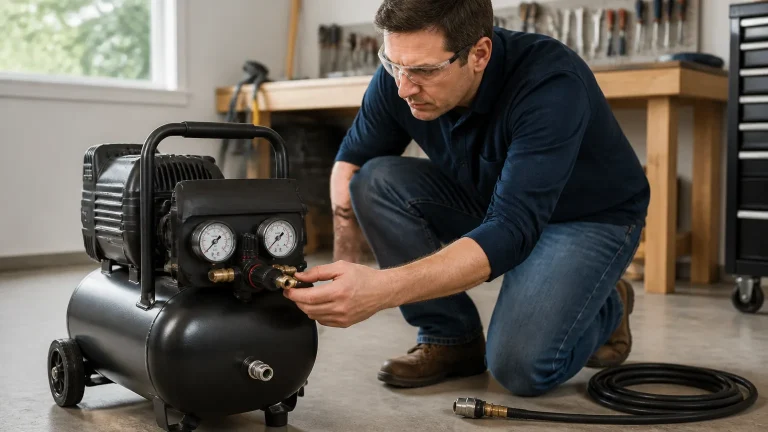
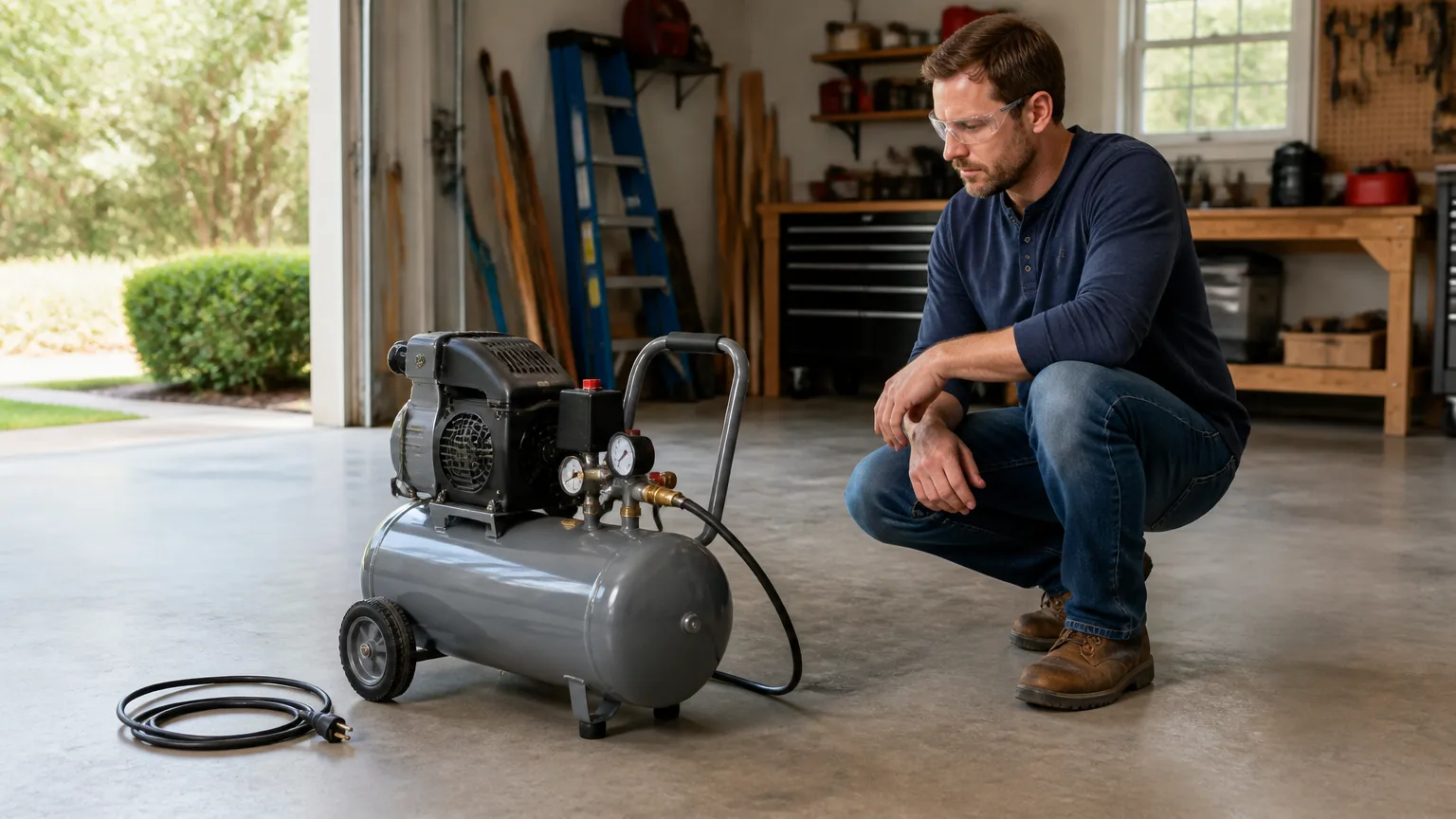
- Confirm that you were reading tank pressure, not outlet pressure. Many compressors have two gauges. The outlet gauge changes with the regulator, while the tank gauge shows stored receiver pressure. A low regulator setting can make the outlet gauge look harmless even as tank pressure is climbing.
- Compare the observed behavior with the exact manual. Look for the model’s stated maximum tank pressure or factory cut-out value. If the compressor normally stopped at one pressure and now consistently passes it, document that observation. If you do not know the model’s specification, do not run repeated “tests” to find it.
- Inspect only externally accessible basics. With power disconnected and the tank depressurized, look for a damaged cord, cracked switch housing, loose external strain relief, burned odor, or obvious corrosion around the control assembly. Do not remove the switch cover just to investigate unless your exact manual specifically authorizes the work and you are qualified to perform it.
- Check whether the symptom is truly a missed shutoff. A brief hiss after normal shutdown can be the pressure-switch unloader releasing trapped head pressure. Campbell Hausfeld explains that this short release helps the motor restart without load. That brief hiss happens after the motor stops; it does not explain a motor that keeps running while tank pressure climbs.
- Arrange service or the correct replacement. If the air compressor pressure switch will not shut off, the switch or its control circuit requires service. The replacement must match the compressor’s original pressure rating and configuration. Do not install a generic switch based only on thread size or appearance.
What the symptoms can—and cannot—tell you
The motor runs past normal cut-out, but the safety valve has not opened
Treat this as an early warning, not a safe condition. A faulty pressure switch, stuck or damaged internal contacts, incorrect prior repair, or a control-setting problem can prevent automatic shutdown. There is no safe benefit to allowing additional pressure to build just to see whether the safety valve will activate.
The motor runs until the safety valve opens
This strongly points to a failed automatic control function, but do not assume the safety valve is the only good component. Shut down, disconnect power if necessary, and do not reset the situation by restarting the compressor. DEWALT support specifically states that a compressor that does not stop building pressure needs pressure-switch replacement by a factory-owned or authorized service center.
The safety valve leaks or opens before the usual cut-out point
That is different from a switch that fails to shut off. The valve may be defective, contaminated, or responding to an actual overpressure condition, and the gauge reading may also be questionable. Either way, do not adjust the valve. Have the machine evaluated using the exact model documentation.
The compressor cycles normally but runs for a very long time
A long run time is not automatically a pressure-switch fault. Large air demand, an open drain, a hose leak, or a leak at a fitting can prevent the tank from reaching cut-out at all. If the tank never reaches normal cut-out pressure, start with a leak and air-delivery check instead. Our guide to finding why an air compressor will not build pressure covers that separate diagnostic path.
When air compressor pressure switch replacement makes sense
An air compressor pressure switch replacement may be appropriate when the compressor repeatedly exceeds its specified cut-out pressure, the switch does not turn the motor off, or a qualified technician finds damaged or welded contacts. However, replacement is not simply swapping a small electrical box.
The switch needs the correct cut-in and cut-out range, electrical rating, connection arrangement, and unloader compatibility for the compressor. Campbell Hausfeld’s replacement-switch instructions caution that the new switch must have the same maximum pressure rating as the original assembly. A mismatched part can create an unsafe operating range or cause starting problems.
For that reason, use the compressor model number to obtain the exact approved part or have an authorized service provider identify it. Do not increase settings for “more air,” substitute a higher-pressure switch, or transfer adjustment settings from a different machine. On compressors with factory-sealed or non-adjustable controls, treat adjustment as service work rather than a DIY tuning task.
Do not use these risky workarounds
- Do not keep operating the compressor because the safety valve still opens.
- Do not block, plug, tie down, or alter the safety valve.
- Do not adjust pressure-switch springs, screws, or calibration hardware without the exact manufacturer procedure and appropriate qualification.
- Do not remove the pressure-switch cover while the compressor is plugged in or the tank contains pressure.
- Do not replace a switch with one of unknown pressure or electrical specifications.
- Do not repeatedly run the compressor into overpressure as a diagnostic test.
- Do not use compressed air to clean your clothing or skin.
The practical bottom line
When an air compressor pressure switch will not shut off, the safe response is simple: stop the unit, prevent another run cycle, verify the issue using the tank-pressure gauge and the exact manual, and arrange proper service. The safety valve is a last line of protection, not a normal control. A compressor that runs beyond cut-out pressure should not return to use until the pressure-control fault has been corrected and the unit can stop automatically at its specified setting.