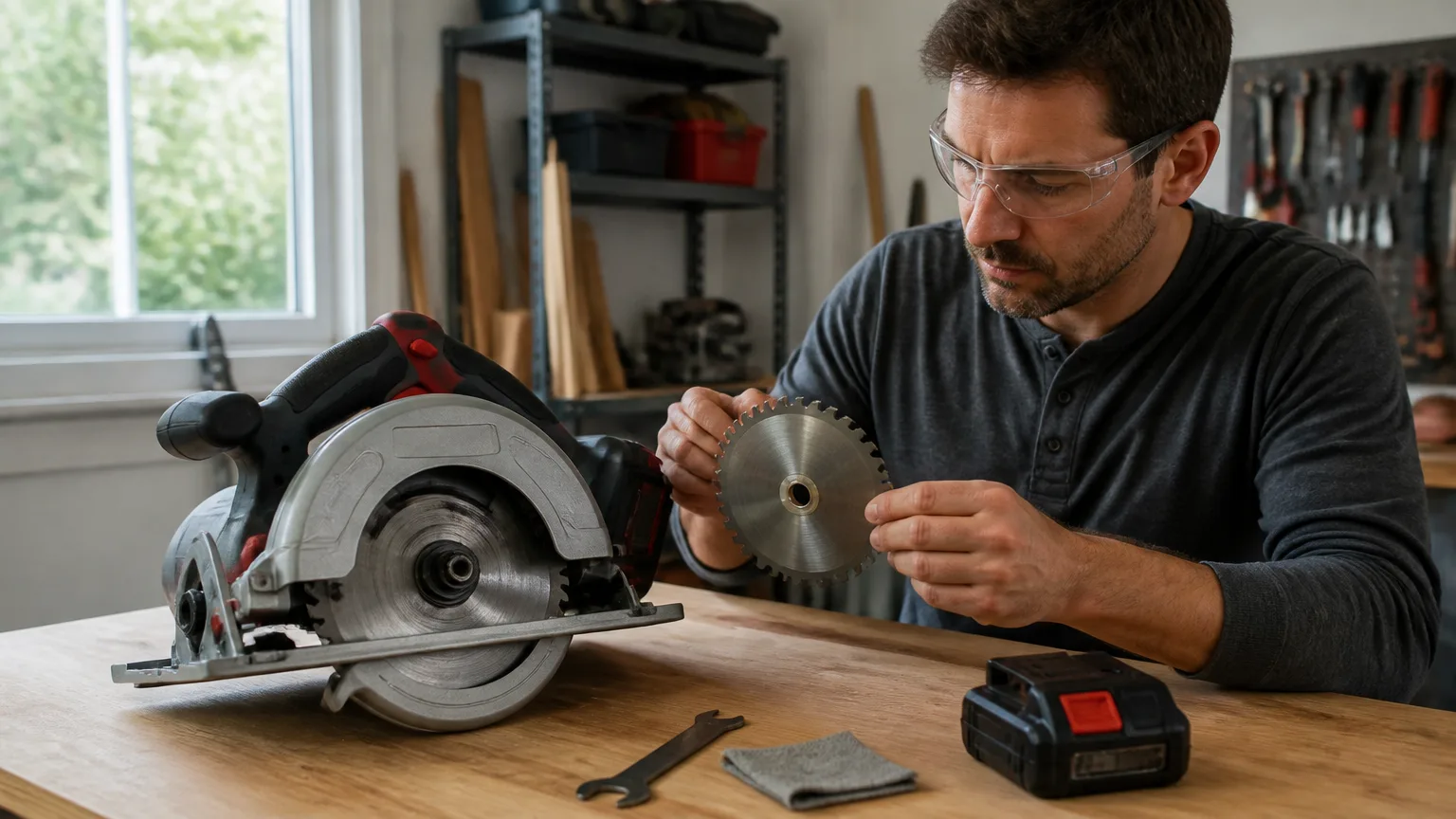
Circular Saw Blade Wobbles: Blade, Arbor, Washer, and Guard Checks
If a circular saw blade wobbles, stop using the saw until you know why. A blade that visibly moves side to side, shakes while cutting, rubs the guard, or leaves an unusually wide or rough kerf can point to a damaged blade, incorrect mounting, debris behind a flange, or a problem at the arbor. The cause is not always the blade itself, and forcing a cut to “see if it clears up” can make the problem worse.
Safety callout: Unplug a corded saw or remove its battery before touching the blade, guard, arbor hardware, or shoe. Do not operate a saw with a damaged, sticking, missing, or altered guard. Wear eye protection for any later test cut, and use the exact owner’s manual for your model when blade hardware or service steps differ.
Portable circular saws are intended to have upper and lower guards, with the lower guard returning to cover the blade when the saw leaves the work. That guard is a safety device, not a part to bend, hold open, or bypass while troubleshooting. If your lower guard is not returning freely, see how to fix a circular saw blade guard that will not retract safely before putting the tool back into service.
What “wobble” can mean
A circular saw blade wobbles complaint can describe more than one symptom. Separating those symptoms helps prevent replacing good parts unnecessarily.
- Side-to-side movement at the rim: Often called blade runout. The blade plate may be bent, debris may be trapped at the mounting surface, or the arbor assembly may have a problem.
- Shaking only in a cut: The saw may be binding in the kerf, the work may be poorly supported, the blade may be dull or unsuitable for the material, or the operator may be twisting the saw.
- A scraping or clicking sound: The blade could be contacting the lower guard, upper guard, shoe, depth mechanism, or a loose component.
- Blade motion with the saw switched off: A blade should be securely clamped when installed. Any obvious looseness at the blade or arbor is a stop-work condition.
Do not confuse a rough cut with confirmed circular saw blade runout. A dull blade, resin buildup, a damaged tooth, a pinched kerf, or a warped board can all make the saw blade shake while cutting without a bent arbor. Start with the simplest checks, then move toward the parts that need professional evaluation.
Circular saw blade wobbles: diagnostic order
- Disconnect power and inspect the blade. Look for a bent plate, cracked body, missing or chipped carbide tips, heavy pitch buildup, heat discoloration, or a distorted arbor hole. Remove a blade with any of these conditions from service. Do not try to straighten a blade or repair carbide teeth at home.
- Confirm the blade matches the saw. Check the owner’s manual and the blade markings for the correct diameter, arbor-hole configuration, cutting application, and speed rating. A blade that does not fit the arbor correctly must not be adapted with homemade bushings, loose spacers, or improvised washers.
- Remove the blade and inspect the mounting stack. Examine the inner flange, outer washer or flange, blade bolt, and the blade faces that contact those parts. Clean off loose sawdust, packed resin, or other contamination with a dry cloth or a method permitted by the saw and blade makers. A small chip trapped behind the blade can prevent it from seating flat.
- Reinstall the blade exactly as specified. Verify the blade direction arrow agrees with the direction marked on the saw or guard. Install every factory part in its intended location and orientation. Tighten the blade bolt using the tool and method stated in the manual; neither undertightening nor overtightening is a reliable fix.
- Check guard movement and clearance. With power disconnected, carefully operate the lower-guard lever. The guard should move smoothly and return fully when released. Look for blade contact marks, packed debris, bent guard components, or a blade that is visibly too large or incorrectly positioned.
- Make a cautious evaluation only after reassembly. If the blade, flanges, and guard appear correct, use a stable, supported piece of suitable scrap material and make a normal, straight cut. Do not force the saw, twist it sideways, or stand in line with a potential kickback path. Stop immediately if vibration, rubbing, wandering, or unusual noise remains.
Blade checks before blaming the saw
Look at the blade plate, not only the teeth
Carbide tips get most of the attention, but the steel plate behind them matters just as much. Lay a removed blade on a known-flat surface only if doing so will not damage the teeth or the surface. A plate that rocks, has an obvious ripple, or has been overheated is not a good candidate for more troubleshooting. Replace it or have it evaluated by a qualified blade service where appropriate.
A dirty blade can also create misleading symptoms. Resin and pitch on the sides of the blade increase friction, encourage heat, and may contribute to wandering or burning. Cleaning may help a blade that is otherwise sound, but it will not correct a bent plate, a damaged arbor hole, or lost teeth.
Use the correct arbor hole and blade configuration
The blade must fit the saw’s arbor as designed. Some saw-and-blade combinations use specific knockout patterns or blade washers. Follow the exact manual rather than assuming one circular saw’s hardware arrangement applies to another. A blade that is loose around the arbor, even when the bolt seems tight, should not be used.
If a replacement blade eliminates the wobble, set the original blade aside rather than reinstalling it later. That comparison is useful: it suggests the issue is at the blade, while persistent wobble with two known-good, correct blades raises concern about the mounting hardware, arbor, bearings, or saw structure.
Circular saw blade flange check: washers and contact surfaces
The inner flange and outer washer or flange clamp the blade flat against the arbor assembly. Their names and shapes vary by manufacturer, but their job is the same: they must contact the blade correctly and apply even clamping force.
- Check both faces for caked sawdust, pitch, burrs, dents, cracks, or obvious distortion.
- Make sure the correct factory flange and washer are present. Do not substitute a random washer that merely fits over the bolt.
- Inspect the blade bolt threads and head for damage. Use only the specified fastener.
- Check that the blade sits fully against the inner flange before the outer flange and bolt are installed.
- Confirm that no accessory, spacer, washer, or blade feature is interfering with the guard or shoe.
A circular saw blade flange check is especially important after a blade change performed outdoors or over a dusty bench. Fine debris can be enough to tilt the blade slightly. If cleaning and careful reassembly remove the problem, continue to watch the saw during future blade changes. Repeat contamination can indicate that blade changes are being done on an unsuitable surface.
When circular saw arbor damage is the likely concern
Circular saw arbor damage is less common than a bad blade or dirty flange, but it deserves prompt attention. With the blade removed and power disconnected, inspect the arbor area for damaged threads, scoring, a visibly bent shaft, a cracked inner flange, or looseness that appears to come from behind the flange rather than from the blade itself.
Do not attempt to bend an arbor back into shape, weld parts, shim the blade with improvised material, or defeat the spindle lock to make a damaged assembly work. Those repairs can compromise blade retention and guarding. If the blade still appears to have circular saw blade runout after you install a known-good blade and correctly inspect the proper washers and flanges, stop using the saw and arrange service with an authorized service professional.
Bearings can also be involved when the saw has a rumbling sound, excessive vibration, heat near the gear or motor housing, or detectable play at the arbor. Bearing and arbor repairs are model-specific. The safe next step is the exact owner’s manual, an approved parts diagram, or professional service—not disassembly based on a generic video or another saw model.
Guard checks that matter when the blade shakes
A guard does not usually cause true blade runout, but it can create a scraping sound or make normal vibration seem much worse. Inspect the lower guard with the saw de-energized. It should not be packed with debris, bent into the blade path, or slow to return. OSHA guidance for portable circular saws calls for guards above and below the shoe, including a lower guard that automatically returns to a covering position when the saw is withdrawn from the work.
Never tie, tape, wedge, or hold the lower guard open during use. If it sticks, catches, or fails to cover the teeth fully after release, correct that issue first. A blade that rubs a properly functioning guard may be the wrong size, incorrectly installed, bent, or part of a saw that has suffered impact damage.
Cutting conditions that can mimic a wobbling blade
If the blade looks true at rest but the saw blade shakes while cutting, review the work setup before condemning the tool. Support both sides of the intended cut so the offcut cannot sag and close the kerf. Keep the shoe flat on the work, guide the saw straight ahead, and allow the blade to cut at its own pace. Do not steer the blade through a curve when making a straight cut.
Also inspect the material. Wet, twisted, or internally stressed lumber can pinch a kerf. Sheet goods need support close enough to prevent sagging. A dull or inappropriate blade may heat up and wander. Use a sharp blade intended for the material and the cut type, as the saw manufacturer specifies.
For related saw safety checks, our guide to a miter saw blade brake that is not working follows the same principle: disconnect power, check only accessible external conditions, and leave internal or model-specific repairs to qualified service.
When to stop troubleshooting and get service
Take the saw out of service if any of the following is present:
- The blade is cracked, bent, missing teeth, or damaged around the arbor hole.
- The lower guard does not move freely and return fully.
- The blade cannot be clamped securely with the correct original hardware.
- The arbor, flange, threads, housing, shoe, or guard shows impact damage.
- Vibration continues with a known-good blade after careful cleaning and reassembly.
- You find arbor play, bearing noise, unusual heat, electrical odor, or intermittent operation.
The practical takeaway is simple: when a circular saw blade wobbles, begin with the blade and its mounting surfaces, then assess the guard and cutting setup. If the problem follows the blade, replace the blade. If it stays with the saw after the proper circular saw blade flange check and installation of a known-good blade, treat the saw as needing professional inspection.