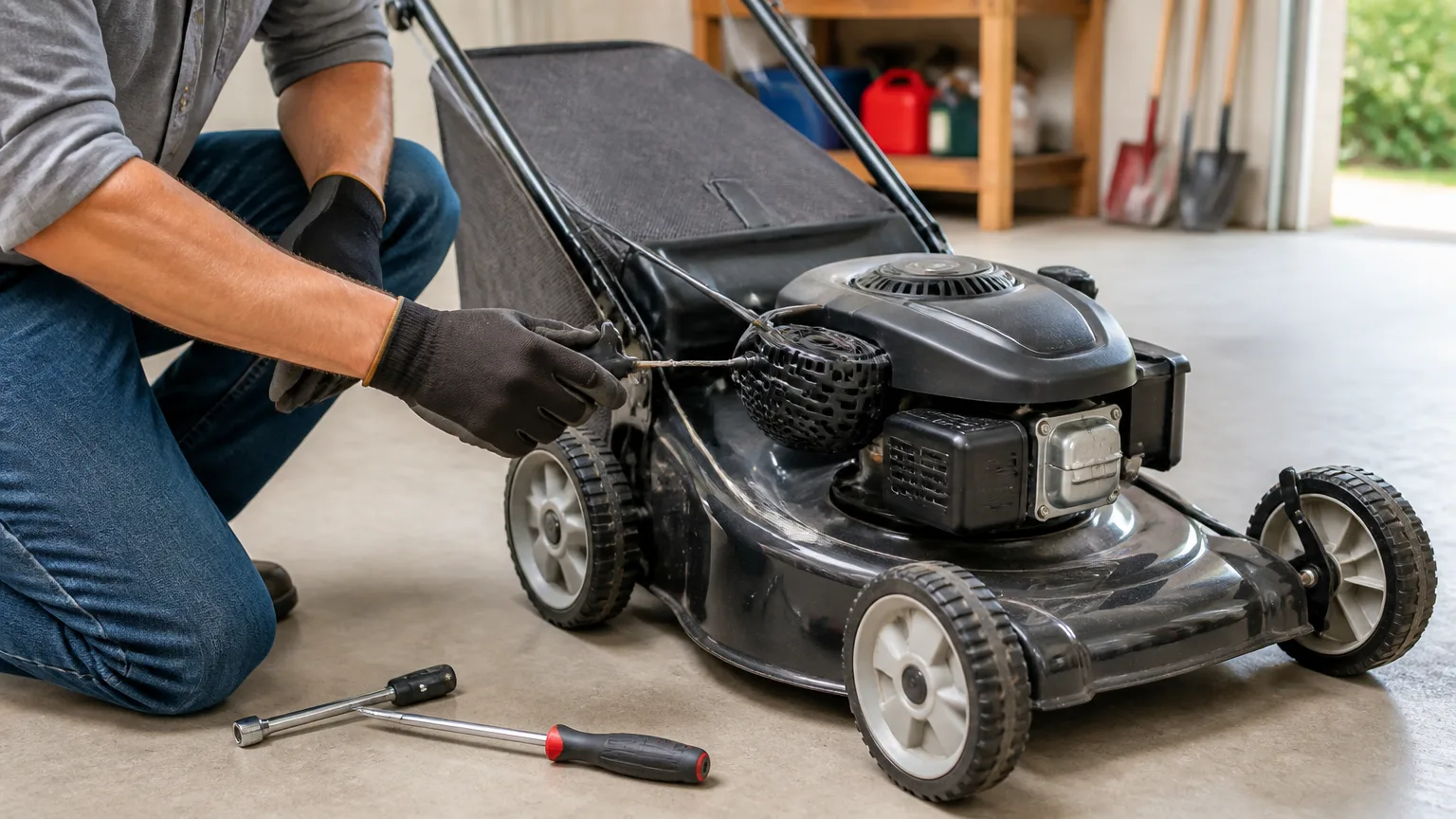
Lawn Mower Pull Cord Is Stuck: What Is Binding the Recoil Starter?
When a lawn mower pull cord is stuck, the recoil starter may be the problem—but it is not automatically the problem. The rope is connected to the engine’s flywheel, so anything preventing the engine from rotating can make the handle feel frozen. A held flywheel brake, packed grass under the deck, liquid in the cylinder, a damaged recoil assembly, or an internal engine fault can all produce a mower cord that will not pull.
Safety first: Stop the engine, allow hot parts to cool, disconnect the spark-plug wire, and keep it away from the plug before inspecting a gasoline mower. Never reach beneath the deck or work around the blade with the engine connected. For corded equipment, unplug it first. Keep all guards and safety controls in place.
The useful question is not simply “Why won’t the rope move?” It is: what is binding—the handle and recoil, the blade/flywheel system, or the engine itself? Start with checks that do not require disassembly, then move toward the recoil housing only after you have ruled out external resistance. If a step requires tipping the mower, removing the blade, or opening engine components, follow the exact owner’s manual for your model or use an authorized service professional.
What a lawn mower pull cord is stuck can mean
A recoil starter converts a pull on the rope into rotation at the engine’s crankshaft. The starter pulley, spring, rope, and engagement pawls must move freely. The engine and blade system also must be able to rotate. That creates two broad failure paths:
- The recoil starter is binding: the rope is tangled, the pulley is damaged, the spring has failed, or the starter pawls do not retract or engage correctly.
- The engine cannot rotate normally: a safety brake may still be applied, debris may be restricting blade movement, the cylinder may be fluid-locked, or the crankshaft/engine may have internal damage.
How the handle behaves offers a clue. A rope that will not extend at all often points toward a jammed rewind pulley or rope. A rope that extends only a few inches and stops solid can indicate engine resistance. A rope that comes out but will not rewind commonly points to a broken or displaced recoil spring. None of these signs is a final diagnosis by itself, so use the diagnostic order below.
Safe diagnostic order for a mower cord that will not pull
- Release the operator-presence control correctly. On many walk-behind mowers, the engine-brake or control bar must be held against the handle while starting. If it is released, the flywheel brake may stop rotation and make the starter rope hard or impossible to pull. Check the owner’s manual rather than forcing the handle. A Husqvarna walk-behind manual, for example, identifies a released engine flywheel brake as a possible cause of a hard-to-pull starter rope.
- Disconnect the spark plug wire and inspect from above. With the mower on level ground and the spark plug wire removed, look for obvious rope damage, a handle pulled tightly against the recoil cover, loose fasteners, or impact damage around the starter housing. Do not pull repeatedly or use tools to pry the rope out; that can turn a minor rope bind into a broken pulley or spring.
- Check for a deck or blade-area obstruction. Grass buildup, sticks, wire, mulch, or a bent blade can prevent or resist rotation. Do not put hands beneath the mower. Follow the model’s manual for safe positioning and deck access; mower designs have different fuel, oil, battery, and handling requirements. Remove only accessible debris with the engine disabled. If the blade has struck an object or appears bent, stop the inspection and have the mower evaluated.
- Consider a flooded or fluid-locked cylinder. If the mower was tipped, stored improperly, repeatedly primed, or pulled through deep water, liquid may be occupying space in the cylinder. Because liquid does not compress like air, the rope can stop abruptly. This is a situation for the exact engine manual or a service professional—especially if fuel or oil is present where it should not be.
- Separate an engine bind from a recoil bind. If external checks do not explain the problem, a qualified next step is to remove the spark plug as directed by the engine manual and check whether the crankshaft turns slowly by hand. Briggs & Stratton advises disconnecting the plug lead, removing the spark plug, and slowly turning the crankshaft to confirm that the engine can rotate. Treat blade movement as hazardous even with the plug wire removed, and do not attempt this if you are not comfortable with the procedure.
- Inspect the recoil starter only after the engine is ruled out. If the engine turns normally but the rope remains stuck, the recoil housing is the likely area. Remove and inspect it only according to the applicable parts diagram and manual. A recoil spring is under tension and can release unexpectedly, so a damaged spring, cracked pulley, or heavily frayed rope is often a sensible repair-shop job.
Common things that bind the recoil starter system
The engine-brake cable or flywheel brake is still applied
This is one of the simplest explanations for a lawn mower recoil starter stuck condition. Many walk-behind mowers use a control bar and cable to release a brake at the flywheel when you prepare to start. A cable that is misrouted, corroded, stretched, or disconnected can keep the brake engaged even when the bar is squeezed.
First, make sure the bar is fully held against the handle as the manual instructs. Then look only for obvious cable damage or a loose attachment. Do not defeat, tie back, bypass, or remove the engine-brake system. It is a safety device. If the cable does not move normally or the brake linkage is questionable, have it repaired with the correct model-specific parts.
Debris is stopping blade or crankshaft movement
Thick, dried clippings can add resistance, while a branch, wire, or other hard object can lock the blade area. This is especially likely after mowing wet grass, hitting debris, or leaving the mower packed with clippings between uses. OSHA guidance emphasizes shutting off mowing equipment, disconnecting the spark plug wire, and allowing moving parts to stop before clearing debris or performing maintenance.
Do not assume a clean-looking deck proves there is no issue. A bent blade, damaged adapter, or crankshaft problem may not be obvious from a quick visual check. If the mower hit a solid object before the rope became stuck, do not keep yanking the starter handle. The impact may have caused damage that needs a closer inspection.
The cylinder is fluid-locked
A sudden, firm stop partway through the pull can happen when fuel, oil, or water has entered the combustion chamber. Incorrect tipping is a common contributor, but it is not the only one. Repeated starting attempts after flooding can also complicate the diagnosis.
Do not force the rope through a suspected lock. Forcing it can damage the recoil assembly or, in a severe case, internal engine components. Consult the engine manual’s procedure for your exact model. If you see significant fuel or oil leakage, smell raw fuel strongly, or are unsure why liquid entered the engine, arrange professional service.
The rope is crossed, frayed, or wedged on the pulley
If the handle barely moves from its resting position, inspect the visible rope carefully. A swollen or frayed rope can wedge where it exits the housing. The rope may also have overlapped itself inside the pulley after a hard snap-back. Do not let a starter grip fly back into the housing; guide it back gently after each pull.
A rope that is badly frayed should be replaced before it breaks. Replacing rope can be straightforward on some designs, but rewind-spring tension and correct routing are model-specific. If you remove the recoil cover, take clear photos of linkage and fastener locations, use the correct manual, and stop if the spring has escaped its pocket.
A broken recoil pulley, spring, or starter pawl is binding
The recoil starter itself can fail when a plastic pulley cracks, a spring kinks or breaks, or the engagement pawls stick. Symptoms may include a handle that will not retract, a rope that pulls without turning the engine, grinding sounds, or a rope that suddenly jams at the same point every time.
These faults generally require removal of the recoil housing. Avoid lubricating indiscriminately inside the starter: oil or grease can collect dirt, contaminate friction surfaces, or cause a repair to behave differently than intended. Use only the lubricant, parts, and adjustment guidance specified in the owner’s manual or service information for the engine.
The engine is mechanically locked or damaged
If the recoil unit checks out but the crankshaft will not rotate with the spark plug removed, the concern shifts from the starter to the engine. Possible causes include severe blade-impact damage, a seized piston, failed internal parts, or a crankshaft that is no longer aligned properly. This is the point to stop troubleshooting at home unless you have the service documentation, correct tools, and experience to evaluate small-engine internals.
A hard engine bind may cost more to repair than a basic recoil issue, but an inspection is still worthwhile before replacing parts. Do not order a recoil assembly just because the pull cord is stuck; a new starter will not correct an engine that cannot turn.
How to inspect a mower recoil starter without making the problem worse
Once you have reasonably confirmed that the engine can rotate and no control or deck obstruction is involved, inspect the recoil system methodically:
- Confirm the spark plug wire remains disconnected.
- Use the exact mower or engine manual to identify recoil-cover fasteners and any shrouds that must be removed.
- Check the rope exit opening for rubbing, pinching, or sharp edges.
- Examine the rope for flat spots, broken strands, knots, or sections that have become too thick to pass through the guide.
- Look for a cracked pulley, loose center fastener, displaced spring, or starter pawls that do not move freely.
- Reinstall every cover, guard, and fastener before attempting to start the mower.
Do not operate the mower with the recoil housing removed or with safety controls disconnected. OSHA standards require guards and proper working condition for power lawnmowers, and the manufacturer’s instructions remain the controlling guidance for your particular machine.
When it is time to stop and book service
Professional diagnosis is the safer choice when the rope kicks back violently, the mower was involved in a blade strike, the engine will not rotate after the plug is removed, fuel or oil is coming from an unexpected location, or the recoil spring has come loose. It is also appropriate when an engine-brake cable needs adjustment or replacement, since that system affects normal stopping as well as starting.
If the cord begins pulling normally again but the mower then starts and dies, the issue may be separate from the recoil system. See why a lawn mower starts then dies after a few minutes for a different diagnostic path.
Bottom line
A lawn mower pull cord is stuck because the recoil starter, the blade-and-flywheel path, or the engine is being prevented from moving. Start with the control bar, spark-plug-wire disconnection, and a careful check for debris. Then rule out fluid lock and engine binding before opening the recoil housing. That order helps prevent unnecessary parts replacement—and avoids turning a manageable starter-rope repair into a safety problem or engine repair.


