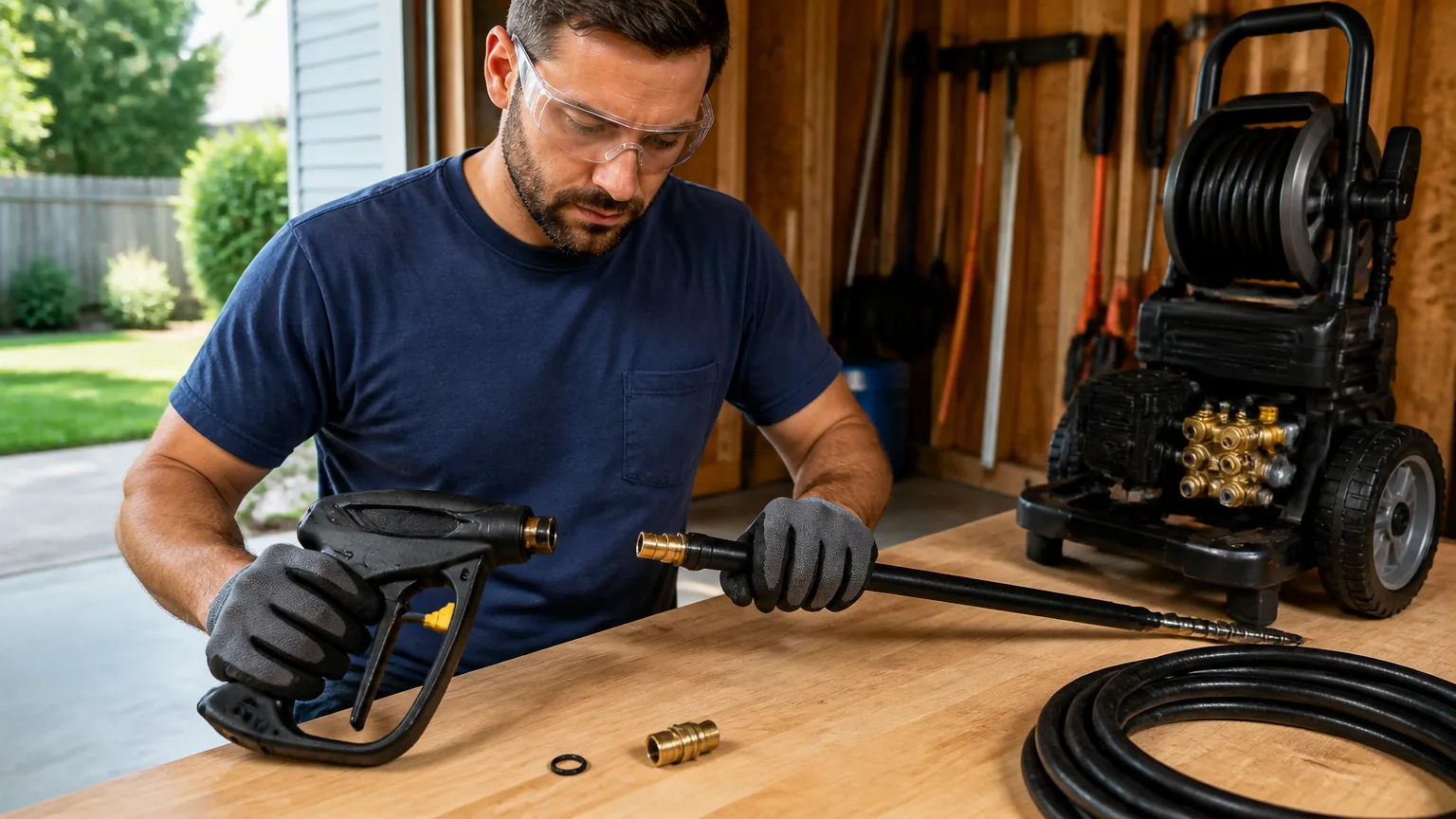
Pressure Washer Trigger Gun Leaking: O-Rings, Fittings, and Replacement Signs
A pressure washer trigger gun leaking problem is often easier to narrow down than it first appears. The important question is not simply whether water is dripping, but where it is leaving the system. A leak at the hose-to-gun or gun-to-wand connection may be caused by a loose fitting, debris, or a damaged O-ring. Water coming from the trigger area, handle seam, or gun body is more serious and commonly points to a spray gun that should be replaced.
Safety first: Shut off the pressure washer and water supply, point the gun in a safe direction, and hold the trigger to relieve stored pressure before disconnecting, tightening, or inspecting any high-pressure connection. Keep the trigger lock engaged while working on the equipment.
Do not try to diagnose a leak with the system pressurized. High-pressure water can cause serious injuries, and a connection that looks minor while the machine is off can worsen quickly under operating pressure. If the high-pressure hose itself is damaged or leaking, discontinue use and replace it; do not patch, tape, or otherwise repair a high-pressure hose. ([simpsoncleaning.com](https://simpsoncleaning.com/troubleshooting-spray-gun-leaking/?utm_source=openai))
How to diagnose a pressure washer trigger gun leaking issue
Start by drying the gun, wand, hose ends, and nearby fittings with a clean cloth. Then restore the water supply and operate the washer only long enough to observe the first point where water appears. Use this quick location check to avoid replacing the wrong part.
- Leak at the gun-to-wand connection: Water appears where the spray wand, lance, or quick-connect extension joins the front of the gun. A worn, missing, pinched, or dirty O-ring is a common cause.
- Leak at the high-pressure hose-to-gun connection: Water appears at the hose fitting on the rear or bottom of the handle. The fitting may be loose, the seal may be damaged, or the hose-end connection may not be seated correctly.
- Leak from the trigger, handle, or gun-body seam: Water seems to emerge from inside the handle, around the trigger pivot, or through a crack in the housing. Treat this as a gun-assembly problem rather than an external fitting problem.
- Leak farther upstream: Water may travel along the hose or wand and make the gun look like the source. Check the hose, inlet connections, and pump area before reaching a conclusion.
For connection leaks, Simpson troubleshooting guidance identifies worn or torn O-rings and loose hose connections as common causes at the gun/spray-wand area. ([simpsoncleaning.com](https://simpsoncleaning.com/wp-content/uploads/7110453-MS-Horizontal-Series-pw-manual-rev-0-12022017-1.pdf?utm_source=openai))
Check the O-rings before buying a new gun
A pressure washer trigger gun O-ring makes a small but important seal between compatible parts. O-rings can flatten with age, tear during installation, swell after chemical exposure, dry out, or get nicked by grit in the fitting. Even an O-ring that looks mostly intact may no longer seal reliably.
What a serviceable O-ring should look like
- It sits evenly in its groove rather than twisted or partly pushed out.
- It is round and flexible, without cuts, flat spots, cracking, or missing material.
- The groove and mating fitting are clean, with no sand, rust flakes, or old seal fragments.
- The connector can be joined fully without forcing, cross-threading, or cocking it at an angle.
If the O-ring is visibly damaged, replace it with the exact size and material specified for the connection in your owner’s manual or parts list. Do not assume that an assorted hardware-store O-ring is suitable for every high-pressure fitting. Different guns, wands, hose ends, and quick-connect systems can use different seals.
Where the exact manual allows it, a very light film of the specified lubricant can help protect and seat an undamaged O-ring. Simpson manuals and support guidance reference white lithium grease for applicable connection O-rings, but your machine’s manual should control if it gives different instructions. ([simpsoncleaning.com](https://simpsoncleaning.com/troubleshooting-spray-gun-leaking/?utm_source=openai))
Inspect fittings when the pressure washer gun leaks at trigger connections
When a pressure washer gun leaks at trigger connections, the wording can be misleading. Water may be dripping near the trigger even though the actual leak is at the hose fitting below or behind it. Inspect each external connection with the pressure fully relieved.
Hose-to-gun fitting checks
- Confirm that the fitting is the correct type for the gun and hose.
- Check that the connection is fully engaged and tightened as the owner’s manual directs.
- Look for a missing seal, damaged threads, a bent coupler, or grit trapped inside the fitting.
- Examine the hose end for distortion, loose hardware, or a leak that starts at the crimp or connector.
A fitting should not require excessive force to seat. Stop if threads resist, a collar will not lock, or the connector appears damaged. Forcing a mismatched or cross-threaded fitting can damage the mating part and create a more significant leak.
Thread sealant or tape is not a universal cure for pressure-washer leaks. Many gun, hose, and wand joints seal with an O-ring rather than the threads, so adding tape to the wrong connection will not fix a damaged seal. Follow the instructions for the specific fitting on your model.
Gun-to-wand fitting checks
If water leaks where the wand enters the gun, disconnect the wand after depressurizing the system. Remove loose debris gently, inspect the O-ring and its groove, and reinstall the wand squarely. Do not use a pointed metal tool that could scratch the sealing surface. Repressurize only after the fitting is fully connected and the gun is pointed safely away from people, animals, windows, and electrical equipment.
A blocked nozzle can also make a machine behave abnormally, although it does not automatically mean the trigger gun is defective. If the leak is accompanied by pulsing, an uneven spray, or unusual pressure changes, inspect the nozzle using the safe process in our pressure washer nozzle cleaning guide.
When a pressure washer gun leaks from handle, replacement is usually the safer path
If a pressure washer gun leaks from handle seams, the trigger opening, or the molded body itself, do not take the gun apart unless the exact manufacturer manual specifically identifies a user-serviceable procedure. Internal trigger valves and seals are not a casual repair area. Simpson’s support guidance says not to repair a leaking spray-gun body and instead replace the gun assembly. ([simpsoncleaning.com](https://simpsoncleaning.com/troubleshooting-spray-gun-leaking/?utm_source=openai))
Replacement is the practical choice when you find any of the following:
- Water escapes from the trigger mechanism, handle shell, or a body seam.
- The gun housing is cracked, deeply gouged, warped, or damaged after a drop or freeze event.
- The trigger does not return normally, sticks, or will not control the water flow predictably.
- The leak remains after cleaning the fitting, installing the correct O-ring, and reconnecting the external parts correctly.
- The hose connection or wand connection cannot lock or seal because the gun-side fitting is damaged.
A pressure washer spray gun replacement should match the connection style, intended hose and wand interfaces, and operating limits specified by the pressure washer manufacturer. A gun that physically connects is not necessarily an appropriate replacement. Consult the exact owner’s manual, model-specific parts list, or an authorized service professional before ordering.
A sensible repair-or-replace decision
Use the simplest safe repair only when the evidence supports it. An external connection leak with an obvious worn O-ring is often a maintenance issue. A leak through the body of the trigger gun is a replacement issue.
- Depressurize and locate the leak. Do not loosen fittings while pressure remains in the hose.
- Address external causes first. Clean the connector, check fitment, and inspect the correct O-ring.
- Use only compatible replacement seals. Refer to the manual or parts diagram for the proper part.
- Test cautiously. Reconnect everything fully, point the gun safely, and check for leaks from a stable operating position.
- Replace a leaking gun body or damaged hose. Do not attempt improvised repairs to high-pressure parts.
Do not overlook related pressure and flow problems
A small gun connection leak can reduce usable pressure, but it is not the only possible cause of weak cleaning performance. If the trigger gun and fittings appear dry yet pressure remains low, check the water supply, nozzle, hose, and pump-side conditions before replacing more accessories. Our guide to a pressure washer with low pressure from the start walks through those checks in a sensible order.
Likewise, do not confuse a trigger-gun leak with water leaking from the pump. Water coming from the pump body, rather than a removable connection, can require professional diagnosis or a pump repair decision. See our overview of pressure washer pump leaks for a separate troubleshooting path.
Bottom line
A pressure washer trigger gun leaking at a removable fitting may be resolved by pressure relief, proper reconnection, cleaning, and the correct O-ring. But water that comes from the gun handle, trigger area, or body is a clear sign to stop using that gun and plan for a compatible replacement. When in doubt, follow the manual written for your exact model or have an authorized service professional inspect the equipment.


